Train Hard. Recover Harder.
Sports Massage in Salt Lake City
Your performance ceiling isn't your training — it's your recovery. Our sports massage therapists understand how muscles respond to demand, how fascia compensates, and how to get you back at 100% faster than any other method available.
What Is Sports Massage?
Sports massage is a targeted, evidence-informed therapy built around one core insight: the limiting factor in any training program is not how hard you can push — it's how completely you can recover. Every high-intensity effort creates microscopic trauma in muscle fibers, triggers an inflammatory response, and produces metabolic byproducts like lactic acid that linger in tissue long after your heart rate returns to baseline. Left unaddressed, these byproducts accumulate across training sessions, gradually reducing your output, narrowing your range of motion, and setting the stage for the overuse injuries that sideline athletes for weeks or months. Sports massage systematically reverses this process: compression and effleurage strokes accelerate lymphatic drainage, flush accumulated metabolic waste, and restore the circulatory environment muscle fibers need to repair themselves at full speed.
Fascia — the connective tissue web that surrounds every muscle group, organ, and bone in your body — is perhaps the least understood recovery variable in athletic training. Under chronic load, fascia loses its elastic quality and begins to adhere to adjacent structures, creating the stiffness and restricted range of motion that athletes often misattribute to tight muscles. In reality, the muscle itself may be perfectly pliable, but the fascial envelope surrounding it has thickened and shortened in response to repeated stress patterns. Sports massage addresses this through specific myofascial release techniques and cross-fiber friction work that manually disrupts adhesion formation and restores the gliding freedom between tissue layers — delivering range-of-motion improvements that no amount of static stretching can replicate.
The distinction between pre-event and post-event sports massage is not merely a scheduling preference — it reflects fundamentally different physiological goals. A pre-event session, scheduled 24 to 48 hours before competition, uses lighter, faster, more activating strokes designed to increase peripheral blood flow, stimulate the neuromuscular system, and sharpen proprioceptive awareness without inducing the parasympathetic shutdown that a deeper session would create. You leave primed, not sedated. A post-event session inverts this entirely: slower, deeper, more deliberate work that prioritizes flushing metabolic waste, reducing acute inflammation, and beginning the structural realignment of tissue that took a beating during competition. Understanding which you need — and getting it at the right time — is what separates athletes who recover in days from those who drag accumulated fatigue into their next training block.
The Benefits of Sports Massage
Six ways consistent sports massage transforms your athletic output — from the track to the weight room to the trail.
Faster Recovery Time
Compression and lymphatic-drainage strokes flush metabolic waste — lactic acid, inflammatory cytokines, cellular debris — from overloaded tissue, restoring the clean circulatory environment muscle fibers need to rebuild between sessions. What took 72 hours now takes 36.
Injury Prevention
Most sports injuries don't appear suddenly — they're the final expression of weeks of unchecked compensation patterns. Your therapist identifies the tissue imbalances, fascial restrictions, and chronic tension holding areas that your body has been quietly working around, and resolves them before they become a diagnosis.
Pre-Event Performance
Activating strokes in a pre-competition session increase peripheral circulation, stimulate Golgi tendon organs, and sharpen proprioceptive signaling — meaning your muscles fire faster, recruit more completely, and communicate more accurately with your nervous system from the first minute of effort.
Improved Flexibility
Chronic adhesions between fascial layers are the hidden ceiling on your range of motion. Cross-fiber friction and myofascial release techniques break up these adhesions at the structural level, restoring length and elasticity that no amount of stretching alone can access — and maintaining it with regular sessions.
Reduced DOMS
Delayed onset muscle soreness isn't inevitable — it's the predictable result of undertreated post-training inflammation. Sports massage dramatically reduces DOMS by accelerating the clearance of the cytokines responsible for that deep, achy soreness, letting you hit your next hard session fresher and at a higher output than you would otherwise manage.
Mental Edge
Elite athletes spend as much time developing somatic awareness as they do training volume. Sports massage cultivates an intimate understanding of what your body feels like when it's ready versus when it's depleted — a body-scan intelligence that lets you make better decisions about effort, load, and rest before your performance suffers.
Your Session, Step by Step
Pre-Session Assessment
Your therapist begins with a brief but precise intake conversation: your sport, training schedule, recent competition or event timeline, areas of chronic tension, any past or current injuries, and the goal for this specific session — pre-event activation, post-event recovery, or ongoing maintenance. This determines every technique and pressure choice that follows.
Identify Load Patterns
The first hands-on minutes are diagnostic. Your therapist reads the tissue — scanning for areas of hypertonic density, restricted fascial glide, asymmetrical tension, and compensatory holding patterns — building a precise map of where your body is carrying the cost of your training load. The places you didn't mention are often the most important findings.
Targeted Treatment
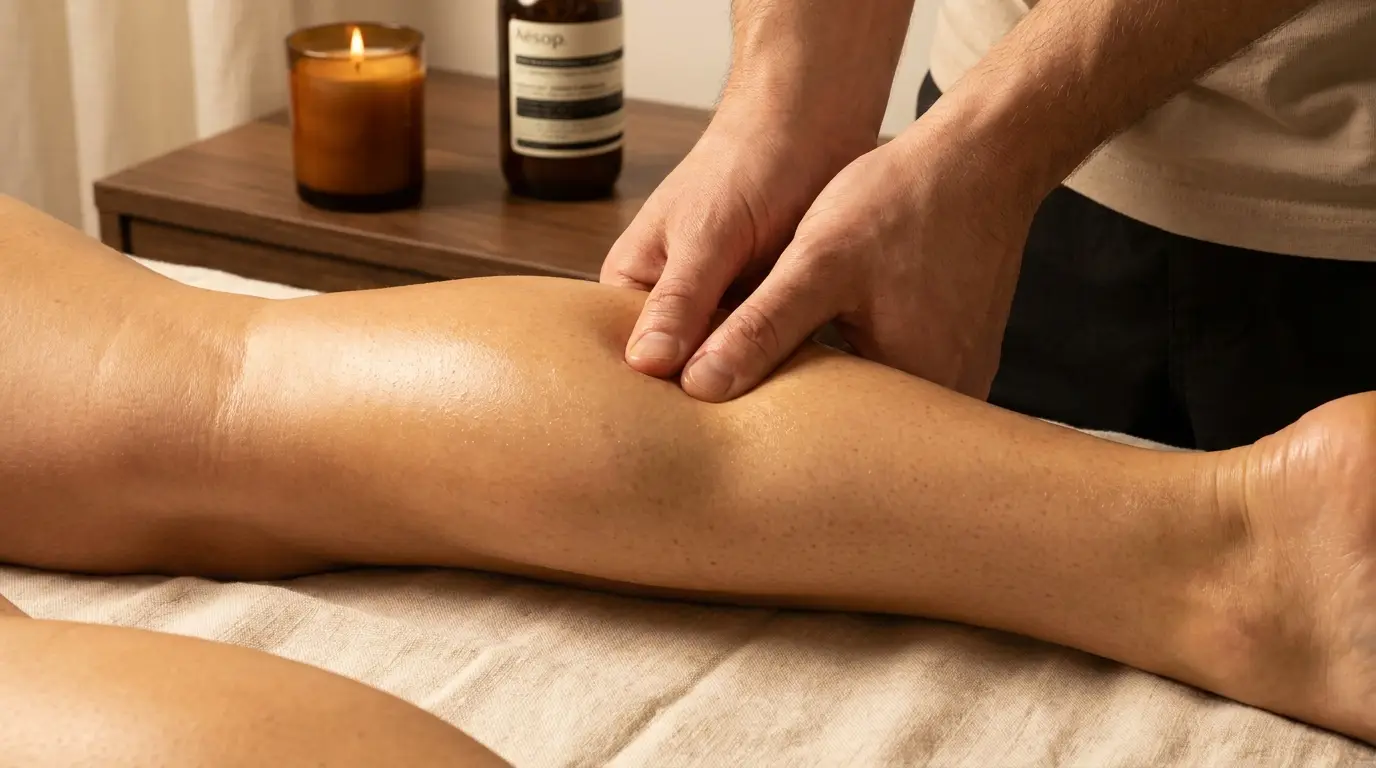
Informed by the assessment, your therapist applies a targeted sequence drawing from effleurage, petrissage, compression, cross-fiber friction, myofascial release, and active or passive stretching as appropriate. The sequence follows the logic of your tissue, not a fixed protocol — adapting in real time as layers release and access to deeper structures opens up.
Recovery Plan
Before you leave, your therapist shares what they found — specific tissue conditions, compensation patterns worth monitoring, and a recommended cadence for your next session relative to your training schedule. You leave not just recovered, but more informed about your body than when you arrived.
Who Sports Massage Serves Best
Endurance Athletes
Runners, cyclists, triathletes, swimmers — anyone whose sport demands sustained output across time. The repetitive-motion nature of endurance sports creates predictable fascial thickening, posterior chain compression, and hip flexor shortening that sports massage specifically targets. Whether you're training for your first 5K or your fifth Ironman, consistent bodywork is the recovery tool that elite endurance athletes have used for decades.
Strength Athletes
CrossFit athletes, Olympic lifters, powerlifters, and recreational gym-goers who train hard and heavy. High-load training creates dense myofascial adhesions, thoracic restriction, and shoulder girdle compression that accumulates faster than it resolves. Sports massage restores the mobility and tissue quality that lets you continue loading safely — and lifts the ceiling on the strength gains your programming is already trying to deliver.
Weekend Warriors
The athlete who goes hard on Saturday and Monday and then sits at a desk for 40 hours in between is arguably at higher injury risk than any other demographic. The combination of sedentary hip flexor shortening, sudden high-output effort, and insufficient mid-week recovery creates a perfect environment for strains and overuse injuries. Sports massage bridges that gap — keeping tissue pliable and ready for the intensity you bring every weekend.
Sports Massage Rates
No membership required. No hidden fees. Book the duration that fits your schedule and your recovery needs.
Sports Massage FAQs
Your Next PR Starts With Your Recovery.
Don't let your muscles be the limiting factor. Book your recovery session today — same-day appointments often available.